

For established e-commerce brands with regular product drops, a strong pre-order strategy can transform customer anticipation into measurable growth. When supported by reliable fulfillment, it reduces risk, boosts revenue, and enhances brand loyalty. From product hype to post-purchase satisfaction, every step needs to be timed, transparent, and scalable.
Badger Fulfillment Group helps brands manage pre-orders from the warehouse floor up. With in-house customer service, custom integrations, and fast, reliable fulfillment, we handle the heavy lifting so your team can stay focused on growth. Whether you’re launching a new seasonal drop or preparing for peak traffic, our systems are designed to keep you moving forward.
Key Takeaways
What is a Pre-Order?
What E-commerce Brands Need
Key elements for Success
Planning & Preparation
How to Set Up Pre-Orders in Shopify
Marketing & Promotion
Order Processing & Fulfillment
Customer Communicaton
Trusted Support for E-Commerce Brands
Fulfillment Services for Pre-Order Success
What is a Pre-order and Why Offer Them
A pre-order lets customers reserve a product before it’s officially available. This model works especially well for brands with a loyal following or limited-edition releases. When planned well, it creates a sense of urgency while giving you time to ramp up production and streamline logistics.
Offering pre-orders helps gauge interest, generate buzz, and reduce financial risk. Instead of overproducing inventory, you can align your supply chain with actual demand. With a trusted fulfillment partner in place, your brand can confidently deliver on customer expectations, even at scale.
What E-commerce Brands Need to Make Pre-orders Work
When running a high-volume pre-order campaign, brands need more than hype and a product release date.
Success depends on clear timelines, accurate inventory visibility, and a fulfillment partner that can scale quickly. Without the right systems in place, delays, missed communications, or overwhelmed support teams can chip away at customer trust. Pre-orders require the ability to monitor demand in real time, prioritize incoming shipments, and get orders out the door the moment product is ready.
Key Elements for a Successful Pre-order Fulfillment Strategy
Each of these elements works together to create a pre-order system that is dependable, scalable, and ready to meet customer expectations from the first click to the final delivery.
Planning and Preparation
Before a single preorder goes live, your internal team and fulfillment partner need a shared roadmap. Clear planning helps prevent bottlenecks and allows your brand to scale confidently. This early phase sets expectations, defines responsibilities, and creates the foundation for a launch that runs smoothly from the first sale to the last shipment.
- Define your target audience: Understand who is most likely to pre-order and what motivates them. This helps shape marketing messages and plan inventory based on real interest.
- Choose a pre-order model: Decide whether customers will pay in full upfront or reserve with partial payment. While the model is flexible, the backend fulfillment must be ready to support it without confusion.
- Set realistic timelines: Align production schedules with your fulfillment partner’s capacity. Timelines should account for receiving, processing, and shipping to avoid over-promising.
- Prepare marketing materials: Pre-orders require coordinated messaging across your website, emails, and ads. Build a campaign that answers questions, builds excitement, and reinforces your brand promise from day one.
- Coordinate with your 3pl: Close collaboration with your fulfillment partner ensures systems, integrations, and timelines are aligned before launch. This preparation allows your 3PL to anticipate warehousing needs, adjust workflows, and keep your pre-order campaign on track from day one.
Once your numbers and timelines are in place, the next step is configuring your e-commerce platform so it can actually support your pre-order strategy.
How to Set Up Pre-Orders in Shopify
Once you’ve decided that pre-orders are the right strategy, the next step is making them work inside your Shopify store. The goal is simple: let customers place orders for items that are not yet in stock while keeping expectations clear and your operations organized.
There are three main pieces to get right:
* How you technically enable pre-orders in Shopify
* How you present pre-order details to customers
* How those orders flow into your fulfillment process with a 3PL like Badger
Let’s walk through each one.
1. Choose your pre-order setup inside Shopify
Most brands use one of two approaches:
Simple “pre-order” button setup
You swap your usual “Add to cart” or “Buy now” button for a “Pre-order” button when inventory is at zero or when you’re intentionally selling ahead of stock. This can be done with:
- A pre-order app from the Shopify App Store
- Custom theme edits if you have a developer
More advanced rules and logic
Growing brands often need more control, such as:
- Only certain variants are available for pre-order
- Pre-orders are allowed up to a specific quantity
- Pre-orders are open only between certain dates
- Choosing full payment vs a partial deposit
Most reputable pre-order apps give you this kind of rule-based logic without custom code. The key is to choose a setup that matches your inventory reality and your production timelines so you’re never promising dates you can’t hit.
2. Make pre-orders obvious and transparent to customers
Shopify makes it easy to change labels and messaging on a product page. Use that to your advantage. Anywhere a customer might look for details of their order, your pre-order info should be crystal clear.
Make sure you:
- Label the purchase as a pre-order at the button level
Replace “Add to cart” with “Pre-order now” or “Reserve your order” so there’s no confusion. - Add a short pre-order note near the price
One or two lines explaining:- That the item is a pre-order
- The estimated ship window (for example, “Ships late October”)
- Any limits (for example, “Limited first run”)
- Include details in the product description and FAQs
Answer the questions customers will have:- When will my order ship
- How will I be charged
- What happens if the date changes
- Can I cancel a pre-order
- Update confirmation emails
Edit your order confirmation templates to:- Re-state that this is a pre-order
- Include the current estimated ship window
- Explain how you’ll share updates if timelines change
A good rule of thumb: if a customer can’t tell it’s a pre-order until after checkout, something in your messaging needs to change.
2. Make pre-orders obvious and transparent to customers
Shopify makes it easy to change labels and messaging on a product page. Use that to your advantage. Anywhere a customer might look for details of their order, your pre-order info should be crystal clear.
Make sure you:
- Label the purchase as a pre-order at the button level
Replace “Add to cart” with “Pre-order now” or “Reserve your order” so there’s no confusion. - Add a short pre-order note near the price
One or two lines explaining:- That the item is a pre-order
- The estimated ship window (for example, “Ships late October”)
- Any limits (for example, “Limited first run”)
- Include details in the product description and FAQs
Answer the questions customers will have:- When will my order ship
- How will I be charged
- What happens if the date changes
- Can I cancel a pre-order
- Update confirmation emails
Edit your order confirmation templates to:- Re-state that this is a pre-order
- Include the current estimated ship window
- Explain how you’ll share updates if timelines change
A good rule of thumb: if a customer can’t tell it’s a pre-order until after checkout, something in your messaging needs to change.
4. Operational guardrails for healthy pre-orders
To keep pre-orders from becoming a support headache, build a few safeguards into your Shopify setup from day one:
- Set realistic ship windows and stick to them whenever possible
- Limit pre-order quantities to what you can actually produce or source
- Create internal rules for when to pause or close pre-orders
- Align your customer service team’s scripts with what’s written on the site
When your Shopify settings, marketing, customer support, and 3PL are all aligned, pre-orders stop being a risk and start becoming a predictable growth tool.
Marketing and Promotion
Marketing a pre-order is about more than announcing a launch. It’s about building momentum and trust in something customers can’t yet touch. Your campaign needs to educate, excite, and remove friction so buyers feel confident purchasing early.
- Build anticipation: Use teasers, behind-the-scenes content, and countdowns to generate buzz. Your goal is to turn interest into action the moment the pre-order window opens.
- Offer incentives: Consider perks like free shipping, early access, or bonus items. These can tip hesitant customers toward ordering and reward your most loyal followers.
- Leverage influencer marketing: Influencers can help validate your product and expand your reach. A strong pre-order campaign often relies on authentic voices to drive early traffic.
- Communicate effectively: From product descriptions to checkout language, clarity matters. Make sure customers know when their order will ship and how to get support if they need it.
Order Processing and Fulfillment
Strong fulfillment is the engine behind every successful pre-order strategy. You can have the best marketing in the world, but if products arrive late or customer updates are missing, trust quickly fades.
According to pwc.com, nearly 80 percent of consumers say speed and convenience are the most important parts of a positive experience.
Fulfillment must be ready to switch from reservation mode to full-speed delivery the moment inventory arrives. That means your logistics partner needs to be integrated, agile, and accountable from day one.
- Prioritize pre-orders: The second your product hits the shelves, pre-orders should be in line for shipment. A fulfillment partner like Badger ensures those early customers get priority, keeping excitement high and frustration low.
- Monitor inventory levels: Overselling creates backlogs and unhappy customers. Real-time inventory tracking gives your brand control and helps avoid making promises you can’t keep.
- Be prepared for returns and refunds: While pre-order customers tend to be enthusiastic, returns still happen. Having an efficient reverse logistics process is part of keeping customers satisfied and your operation clean.
Customer Communication
Inc.com found that about 94 percent of consumers say they would be loyal to a brand that offers complete transparency. [JH1] So, your communication plan can make or break the entire pre-order experience. These customers are buying before they see a product, which means they’re relying on your brand to keep them informed and reassured. That starts with transparency and continues all the way through delivery.
- Provide regular updates: From order confirmation to estimated delivery, keep customers in the loop. Even a short message like “Your item is on track to ship next week” helps maintain trust and reduce support requests.
- Be responsive to inquiries: Customers who preorder tend to be your most engaged. Offering fast, helpful responses shows that your brand values their early commitment and builds loyalty over time.
- Gather feedback: Once the dust settles, check in with those customers. Their experience will offer valuable insights for improving your next launch and refining your fulfillment process.
The best pre-order strategies are built on preparation, communication, and reliable fulfillment. When those elements come together, brands can turn excitement into measurable results. A recent example from LEGO shows what that looks like in practice.
Lessons from LEGO’s Game Boy™ Pre-Order Campaign
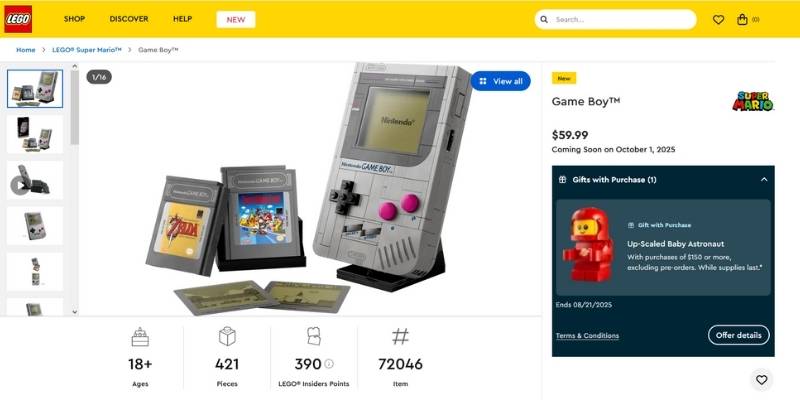
When LEGO announced its Game Boy™ model set (No. 72046), the company proved how powerful a well-timed pre-order strategy can be. The campaign offered more than nostalgia. It demonstrated what happens when marketing, logistics, and fulfillment align seamlessly to meet global demand.
Building Anticipation Before Launch
LEGO first revealed the Game Boy set in July 2025, opening pre-orders ahead of the official October 1 release date. The announcement combined storytelling and precision timing, two key drivers of pre-order success. By pairing a beloved retro product with limited early access, LEGO built excitement while giving customers a clear reason to act fast.
Industry outlets such as Polygon and Nintendo.com highlighted the announcement immediately, reinforcing the launch timeline and linking directly to pre-order availability. LEGO’s consistent communication across platforms gave fans confidence that their early purchase would be handled smoothly, something every e-commerce brand can learn from.
Demand and Fulfillment in Motion
Within days of opening pre-orders, LEGO’s online store sold out in several regions. GameSpot reported that pre-orders “sold out in less than 24 hours,” while Esquire noted that the set “was already sold out on LEGO’s site” within the first week. Resellers began listing the product at double retail price, according to Resell Calendar, signaling strong market demand and a successful pre-sale campaign.
Behind the excitement was precise operational planning. LEGO’s systems were ready to transition from reservation to fulfillment mode the moment inventory arrived, a critical step in maintaining momentum. Brick Fanatics later reported that pre-orders briefly reopened in the U.S., suggesting that stock was replenished efficiently to meet continued interest.
Regional Insights and Inventory Management
The campaign’s global performance also offered a lesson in demand forecasting. While pre-orders surged in North America, some European retailers reported early restocks and eventual discounting within weeks of release (Brick Fanatics). This variation highlights the importance of real-time inventory visibility and flexible fulfillment. For e-commerce brands, that means having systems in place to balance demand across markets and prevent oversupply.
What E-Commerce Brands Can Learn
LEGO’s Game Boy launch shows that successful pre-orders require both hype and follow-through. From day one, communication was clear, demand was tracked closely, and fulfillment adapted in real time. For growing brands, these same principles apply, just on a smaller scale.
The takeaway is clear: when preparation, communication, and fulfillment work in sync, pre-orders become more than a sales tool, they become a way to strengthen customer trust and build long-term loyalty.
That level of reliability is what we deliver every day.
Trusted Pre-order Support for E-commerce Brands
Badger Fulfillment Group helps e-commerce brands take control of their pre-order strategy from the ground up. We understand how important timing, transparency, and trust are to your customers. That’s why our fulfillment process is designed to be responsive and reliable. Whether you’re preparing for a seasonal drop or managing multiple SKUs, we stay in sync with your team to ensure every order meets your standards and every launch runs smoothly.
- Plan early and align teams. LEGO’s timeline was set months in advance, ensuring marketing, production, and fulfillment worked together from launch through delivery.
- Keep communication consistent. Updates across media channels built trust and urgency.
- Prioritize fulfillment readiness. Pre-orders only strengthen brand loyalty when products ship on time and expectations are met.
At Badger Fulfillment Group, we help brands turn that kind of precision into repeatable success. From real-time inventory tracking to seamless order transitions on launch day, our systems are built to handle the same coordination that makes campaigns like LEGO’s stand out. When your next product drop goes live, we make sure your pre-orders ship fast and your customers stay excited.
Fulfillment Services Designed for Pre-order Success
Badger Fulfillment Group offers services tailored to the needs of brands that run pre-order campaigns:
- Hands-on onboarding with your dedicated team
- Integrations with your e-commerce platforms
- 24-hour receiving to get inventory ready fast
- Affordable 2-day shipping options
- In warehouse customer service that knows your products
- Inventory visibility to track stock and availability
- Returns management to protect customer relationships
- Kitting and assembly if needed for bundled or multi-part orders
Every great pre-order strategy starts with strong planning, but it’s execution that defines your brand. When customers commit early, they expect communication, consistency, and fast delivery. The right fulfillment partner makes all that possible. With Badger Fulfillment Group, you get a team that’s built to support your growth and deliver on your promise.
Ready to launch a pre-order strategy that keeps customers coming back? Contact Badger Fulfillment Group to build a fulfillment plan that works for your brand.